
Uncategorized
WGU Master's Degree Rankings 2026 | I Asked 3 AIs 300 Times to Find the Best One
Table of Contents
- Which WGU Master’s Degree Is Actually Worth It?
- Why Ask an AI 300 Times? Here’s the Method
- WGU Master’s Degree Rankings 2026 — Full Results
- #1: MS Cybersecurity and Information Assurance — Consistently Dominant
- #2: MS Software Engineering — Not Dead. Just Evolving.
- #3: MS Computer Science – AI and Machine Learning — The Personal Pick
- Programs #4 Through #9 — Quick Reference
- The Job Market Isn’t Broken — Your Approach Might Be
Which WGU Master’s Degree Is Actually Worth It?
If you’re considering a master’s degree from WGU and can’t figure out which program to choose — cybersecurity, software engineering, AI/ML, data analytics — you’re not alone. The options are overwhelming, and most comparisons online are either outdated or purely opinion-based.
So here’s a different approach. I’ve been through this myself — I hold a master’s in cybersecurity from WGU, a few IT-related bachelor’s degrees, and a CISSP. I know what it’s like to stare at that list of programs and wonder which one is actually worth your time and money. That’s exactly why I wanted to answer this with data, not gut feeling.
I asked three separate AI models the same question 300 times and let the results speak for themselves. This article breaks down the full ranking of all 9 WGU IT master’s programs — so you can make a more informed decision about where to invest.
Why Ask an AI 300 Times? Here’s the Method
The Problem With Asking an LLM Just Once
Large language models don’t give you the same answer every time. Ask the same
question twice and you’ll often get two slightly different responses. That means
a single query isn’t reliable enough to base a major career decision on.
To get around this, the following approach was used:
- Three models were tested: GPT-4o, GPT-5.1, and GPT-5.2
- Each model was asked the same ranking prompt 100 times each (300 total)
- Every response included a written justification explaining why each degree
was ranked where it was - All results were aggregated into a spreadsheet to calculate average rankings
and standard deviation
The result: a statistically grounded consensus rather than a one-off opinion.
What Each Degree Was Evaluated On
Every prompt included the full curriculum details for each WGU program — pulled
directly from WGU’s official website — so the models weren’t just guessing.
They evaluated each degree against five criteria:
- Job demand (current market need)
- Salary potential (earning impact post-graduation)
- Versatility (applicability across industries and roles)
- Automation resistance (how likely the role is to be disrupted by AI)
- Growth trajectory (projected demand over the next several years)
WGU Master’s Degree Rankings 2026 — Full Results
Overall Ranking (All 9 Programs)
Here’s the full consensus ranking, averaged across all 300 rounds and all 3 models:
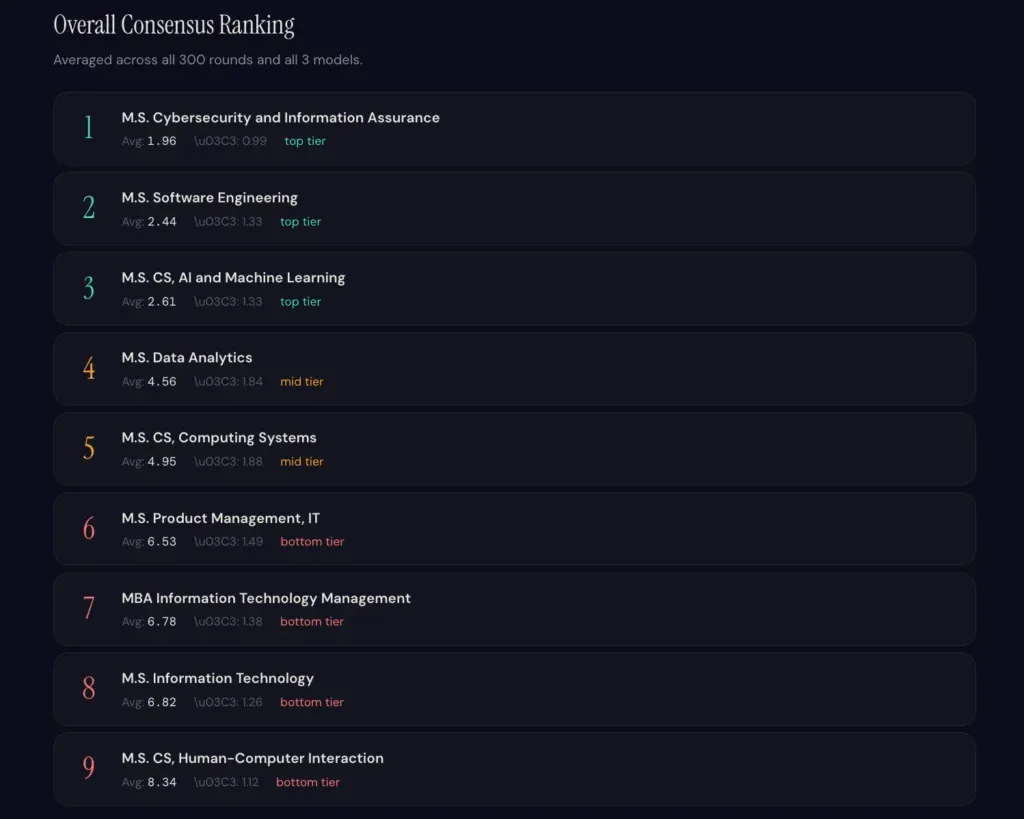
The full spreadsheet and detailed analysis report from this study are available to see below.
📊 See the full data and analysis report
The Top 3 Are Extremely Close — Don’t Overthink It
One of the most important takeaways from this data is just how tight the spread
is at the top. The gap between #1 (1.96) and #3 (2.61) is less than one point.
If you’re trying to “min-max” your degree choice, the honest answer is: any of
the top three will serve you well. The more important factor is which program
aligns with your career goals and existing skill set.
#1: MS Cybersecurity and Information Assurance — Consistently Dominant
Why It Ranked First in 90% of Justifications
The cybersecurity master’s wasn’t just the overall winner — it was remarkably
consistent. With a standard deviation of just 0.99, it ranked #1 or #2 in
almost every single one of the 300 responses across all three models.
In 90% of the written justifications, the models cited cybersecurity by name as
the top-ranked degree. The reasoning was consistent: strong and growing job
demand, high salary ceilings, and a field that becomes more critical — not less
— as organizations become more digitally dependent.
One Important Caveat: Certifications Often Matter More Than the Degree
That said, it’s worth being honest about something: in the cybersecurity field,
a master’s degree is rarely the deciding factor in getting hired.
Certifications like the CISSP are widely considered more valuable than a
graduate degree when it comes to practical hiring decisions. The degree helps —
but it’s one piece of the puzzle, not the whole picture. Hands-on experience and
recognized certifications tend to carry more weight with employers.
#2: MS Software Engineering — Not Dead. Just Evolving.
”Software Engineering Is Dead” — Why That Take Is Wrong
You’ve probably heard it: AI is going to replace software engineers. While
there’s a kernel of truth here, the full picture is more nuanced.
The old way of doing software engineering — writing every line of code manually,
working in isolation from AI tools — is changing fast. In some respects, it’s
already changed. But that doesn’t mean software engineering as a discipline is
disappearing.
What the New Software Engineer Actually Does
The role is being redefined, not eliminated. Going forward, software engineers
will increasingly focus on:
- Orchestrating AI tools and LLMs to generate, review, and integrate code
- Providing accurate context and requirements so AI produces useful output
- Migrating legacy systems and building new infrastructure alongside AI
- Making architectural decisions that AI tools alone can’t reliably make
The newer models — GPT-5.1 and GPT-5.2 — actually ranked software engineering
first in their individual results, citing broad applicability and strong demand
heading into 2026. The most up-to-date AI, it seems, is bullish on software
engineering’s future.
#3: MS Computer Science – AI and Machine Learning — The Personal Pick
If the author of this analysis were choosing a second master’s degree today
(having already completed the cybersecurity MS), this would be the one.
It ranks third overall — not because it lacks value, but because the current
job market for dedicated AI/ML roles is slightly narrower than cybersecurity or
software engineering. However, on a forward-looking basis, the growth trajectory
here is arguably the strongest of any program on the list.
As AI continues to penetrate every industry, the people who can actually design,
implement, and improve AI systems will become increasingly valuable. If you’re
optimizing for where the market will be in five years rather than where it is
today, this program deserves serious consideration.
Programs #4 Through #9 — Quick Reference
These programs aren’t bad choices — they’re just more specialized or have a
lower overall ROI compared to the top three.
#4 MS Data Analytics: Strong for data-driven business roles. A solid
pick if you’re targeting analytics or BI positions.
#5 MS CS – Computing Systems: Best suited for infrastructure, embedded
systems, or low-level engineering roles.
#6 MS Project Management: A good option if you’re transitioning from a
technical role into management. Less differentiated in a crowded market.
#7 MBA in IT Management: Bridges business and technology. Useful for
leadership tracks, but the ROI is lower than the technical master’s programs.
#8 MS Information Technology: Broad and flexible, but harder to
differentiate yourself with this credential alone.
#9 MS CS – Human-Computer Interaction: A niche program best suited for
UX research or product design roles. High specialization, limited scope.
The Job Market Isn’t Broken — Your Approach Might Be
A common frustration among job seekers right now is the sense that something is
wrong with the market — that the hiring process is broken, that applications
disappear into a void, that getting a job is harder than it should be.
Here’s a more useful way to look at it: the market has changed, not broken.
AI is raising the bar for what employers expect from tech professionals. The
strategies that worked three or five years ago — the same resume formats, the
same skill sets, the same job search playbook — are simply less effective now.
That’s not a malfunction. It’s evolution.
What actually moves the needle in 2026:
- Learning to use AI tools fluently within your area of specialization
- Building visible proof of your skills (portfolio, open-source work, content)
- Applying with consistency, volume, and genuine alignment to the roles you target
If you stay marketable and keep executing, results follow. Blaming the market
is a mindset that keeps you stuck.
Final Takeaway: Which WGU Master’s Should You Choose?
Based on 300 AI-generated rankings across three models, the top three WGU
master’s programs in 2026 are:
#1 MS Cybersecurity and Information Assurance
#2 MS Software Engineering
#3 MS CS – AI and Machine Learning
These three are separated by less than one point on average — meaning any of
them is a strong choice. The deciding factor should be your personal career
direction, not minor differences in aggregate scores.
And regardless of which program you choose, remember: the degree is a tool, not
a guarantee. Pair it with relevant certifications, real hands-on experience, and
a genuine ability to leverage AI in your field — and you’ll be in a strong
position no matter where the market goes next.