
Uncategorized
IAM Careers Explained: Is CISSP Actually Required? A Data-Driven Roadmap to $124K-$174K
Table of Contents
- Breaking Into IAM: What 100 Real Job Postings Actually Show
- Certification Requirements: The Real Numbers
- Does a Degree Actually Matter?
- The IAM Platforms You Need to Know
- Scripting Skills: PowerShell Wins, No Contest
- Cloud Platforms Are Becoming Non-Negotiable
- Compliance Frameworks Worth Knowing
- Work Arrangement Reality Check
- Salary: The Numbers Everyone Actually Wants
- Job Title Breakdown
- The Roadmap: 7 Practical Steps to Break Into IAM
- Step 1: Get Security+
- Step 2: Get SC-300 or an Okta certification
- Step 3: Learn one major identity governance platform (SailPoint or Okta)
- Step 4: Get comfortable with PowerShell
- Step 5: Understand the basics of SAML, OAuth, and OIDC
- Step 6: Get hands-on experience with Active Directory and Entra ID
- Step 7: Target the roughly 22% of entry-level-accessible positions
- Bottom Line
Breaking Into IAM: What 100 Real Job Postings Actually Show
Hi, I’m Josh Madakor. I run a hands-on training community focused on cybersecurity careers, and inside that community, I get asked constantly how to break into IAM.
IAM (Identity and Access Management) is the part of cybersecurity focused on controlling who has access to what inside a company — usernames, permissions, logins, and who can see which data.
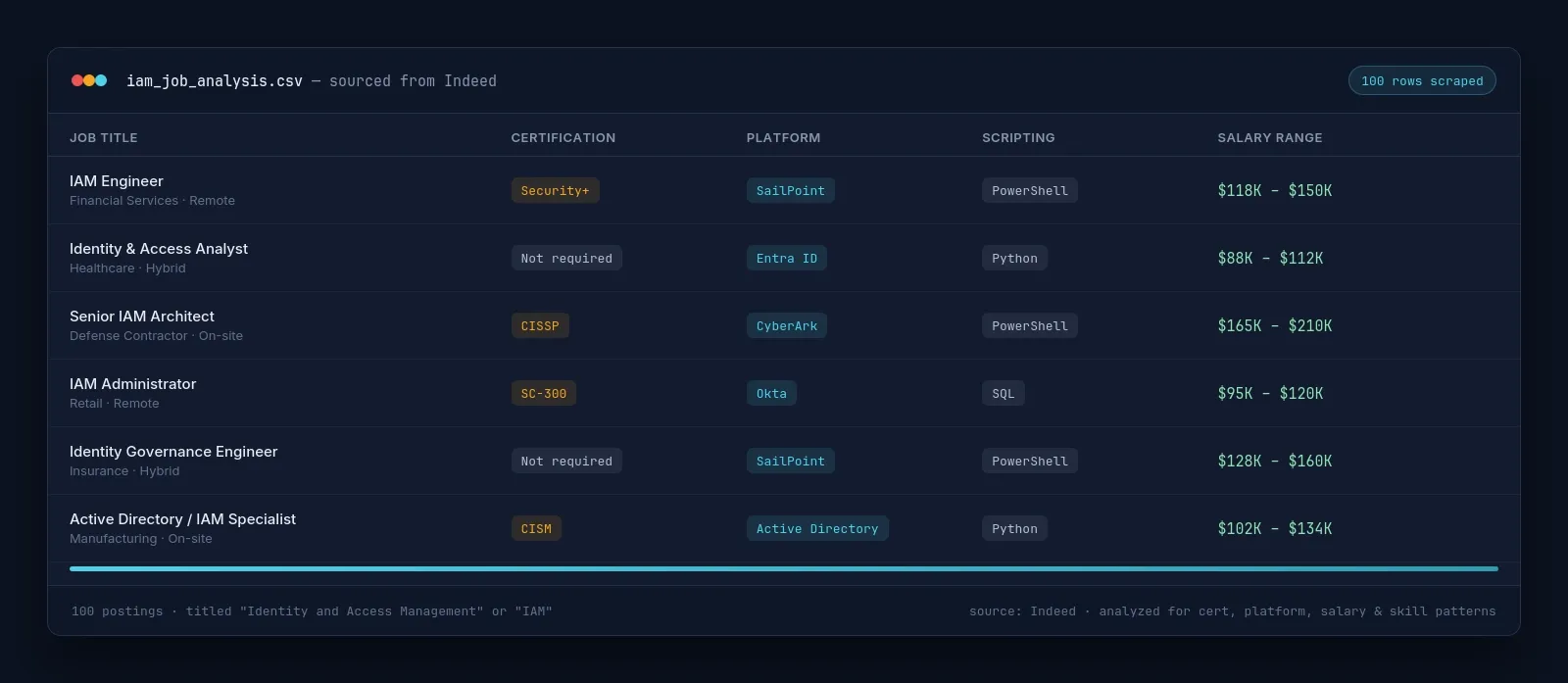
So instead of guessing, I pulled 100 real IAM job postings from Indeed — scraping the titles, descriptions, and salaries — and ran a full analysis on the data to break down exactly what it takes to get into this field.
I’ve personally done IAM-related work in almost every cybersecurity job I’ve had, but I’ve never held a dedicated title like “IAM Engineer” or “IAM Analyst.” So some of what’s in this data is stuff I’ve never worked with directly myself — which is exactly why I think it’s worth breaking down carefully instead of guessing.
I’ve also put together a roadmap at the end of this post, so stick around for that.
About the author
- Started in IT in 2007 as a help desk technician, then moved into cybersecurity roles across government, finance, and private industry
- Worked as a Microsoft contractor and contributed to the Microsoft Cloud Security Benchmark
- Grew a YouTube channel teaching this stuff to 220,000+ subscribers
- Currently runs the Cyber Community and the Cyber Range
A note on the data: this comes from 100 U.S.-based job postings on Indeed with “Identity and Access Management” or “IAM” in the title, scraped and analyzed for patterns in certifications, platforms, skills, and salary. It’s a snapshot of the current market, not a scientific study — 100 postings is a limited sample, and job boards shift over time. But it’s real listing data, and the patterns are consistent enough to be useful for deciding where to focus your time.
Certification Requirements: The Real Numbers
Let’s start with certifications — this is where most people overthink things.
| Certification | % of Jobs Requiring It |
|---|---|
| CISSP | 34% |
| CISM | 18% |
| Security+ | 8% |
| Okta certifications | 6% |
| CCSP | 5% |
CISSP tops the list, but 82% of those CISSP mentions are for senior-level roles. So if you’re entry-level, deprioritize chasing CISSP for now. And 55% of these jobs don’t require any certification at all — more than half don’t even mention one. So the smarter move at entry-level is focusing on the certifications below instead: they’re more accessible and map more directly to roles you can actually land right now.
Certification Strategy for Entry-Level
Get Security+
This is the baseline certification most employers expect, even when they don’t explicitly require IAM-specific certs.
Get one platform certification (SC-300, Okta, or SailPoint)
Of these three, SC-300 is the most accessible: the training is free via Microsoft’s official SC-300 learning path, and the exam itself costs under $150 (I’ve linked a free SC-300 practice question deck at the end of this post if you want to study with it). I haven’t confirmed whether Okta or SailPoint offer free training paths.
Does a Degree Actually Matter?
Only 24% of these jobs explicitly require a bachelor’s degree. That means 76% don’t mandate a degree at all — the focus is much more on skills and hands-on experience than credentials on paper.
The IAM Platforms You Need to Know
Here’s where to actually spend your lab time:
| Platform | % of Jobs | What It’s Used For |
|---|---|---|
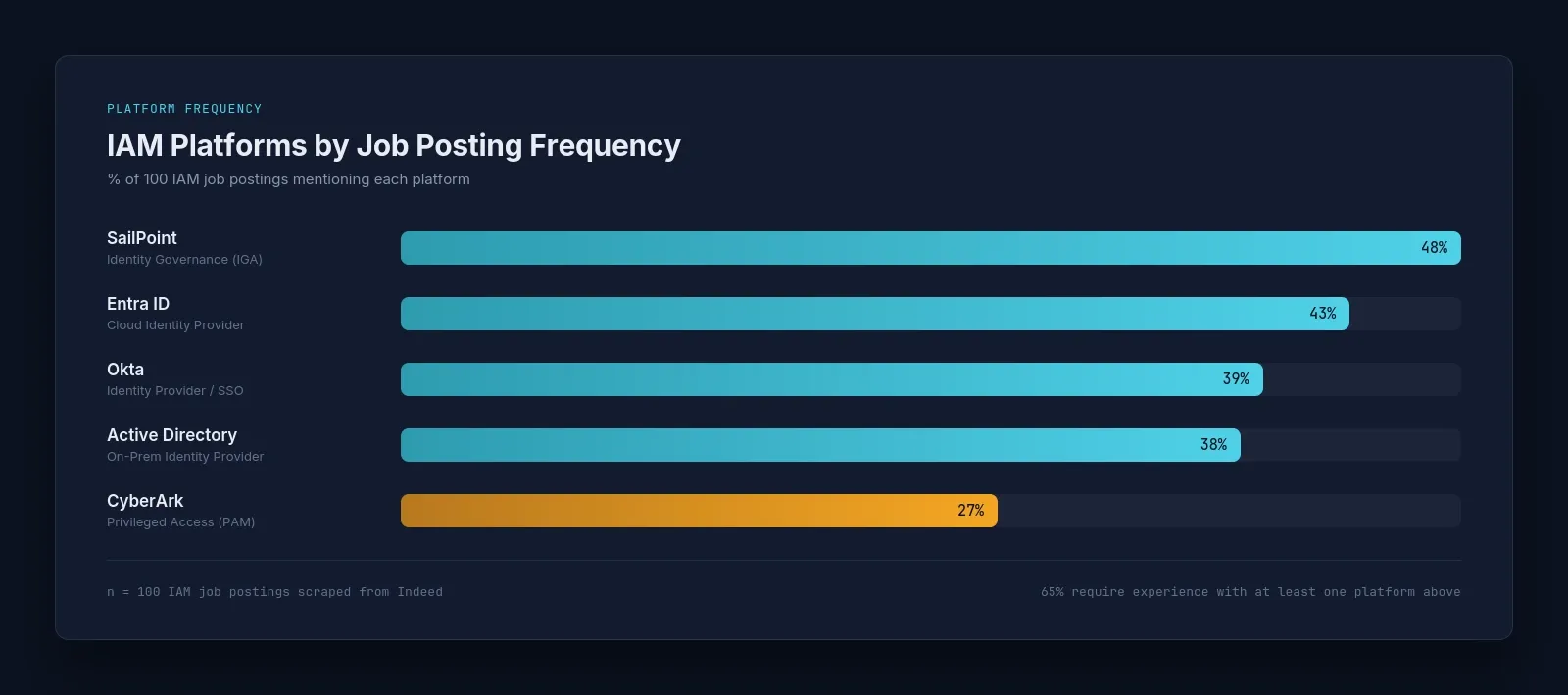
| SailPoint | 48% | Identity Governance (deciding who should have access to what) |
| Entra ID (formerly Azure AD) | 43% | Cloud-based identity and login management |
| Okta | 39% | Identity provider (single sign-on, login management) |
| Active Directory | 38% | On-premises identity provider used by most traditional companies |
| CyberArk | 27% | Privileged Access Management, or PAM (controlling admin-level accounts) |
At least 65% of IAM jobs require experience with at least one of these platforms, and 27% require both Okta and SailPoint together. So knowing more than one platform is a real differentiator. If you only have time to build one hands-on lab, make it Active Directory — it shows up in more listings than any single cloud platform, and it’s completely free to set up yourself.
If you want to get familiar with these platforms without paying for vendor training, most of them offer free self-paced learning portals: Okta Learning Portal, SailPoint Identity University, and CyberArk University.
Scripting Skills: PowerShell Wins, No Contest
This is the stat that genuinely surprised me, so I went back and double-checked the raw data myself:
| Skill | % of Jobs Requiring It |
|---|---|
| PowerShell | 34% |
| Python | 28% |
| SQL | 20% |
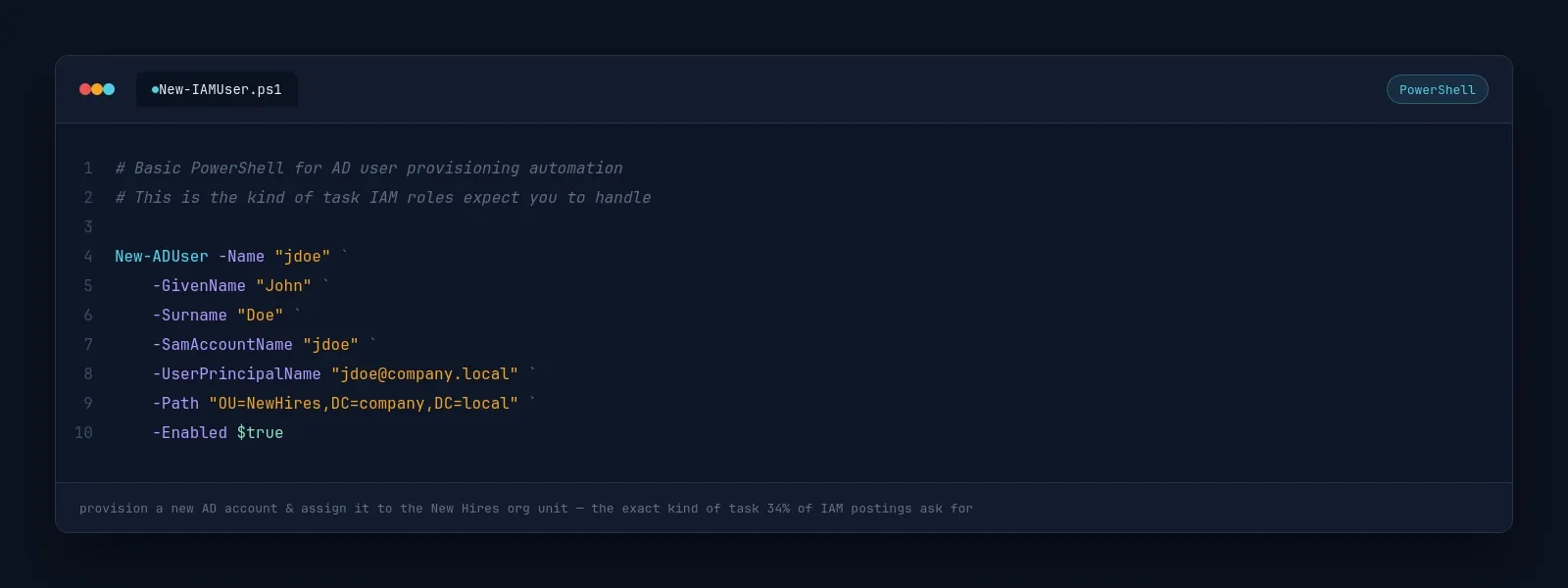
A third of all IAM job postings specifically ask for PowerShell. On top of that, 40% of jobs require at least Python or PowerShell, and 22% require both. So PowerShell and Python are your must-haves, SQL is a nice-to-have, and being comfortable calling APIs will set you apart further.
If you want a genuinely free way to build real Python fundamentals from scratch, I put together a full walkthrough here: Python Fundamentals for IT & Cybersecurity.
Cloud Platforms Are Becoming Non-Negotiable
| Cloud Platform | % of Jobs |
|---|---|
| Azure | 41% |
| AWS | 30% |
| GCP | 9% |
46% of jobs mention at least one cloud platform, and 26% mention two or more. So if you’re deciding where to focus, SC-300 is the most efficient starting point — free training, free Azure access, and it directly covers identity and access administration. If you’d rather practice in a live, real-world environment instead of a personal sandbox, that’s the kind of hands-on Azure experience the Cyber Range is built around.
Compliance Frameworks Worth Knowing
A compliance framework is basically a rulebook — a set of standards companies have to follow to protect data, whether required by law or by industry standard. You don’t need to master these at entry-level, just recognize the names.
| Framework | % of Jobs |
|---|---|
| NIST | 21% |
| SOC 2 | 17% |
| HIPAA | 16% |
| GDPR | 15% |
| ISO 27001 | Lower, trailing off from there |
Work Arrangement Reality Check
| Arrangement | % of Jobs |
|---|---|
| Remote | 30% |
| Hybrid | 26% |
| On-site | 23% |
| Full-time | 23% |
| Contract | 19% |
(These don’t add up to 100% because postings often overlap categories — a role can be listed as both remote and contract, for example.)
Salary: The Numbers Everyone Actually Wants
| Metric | Amount |
|---|---|
| Lowest listed salary | $72,000 |
| Highest listed salary | $258,000 |
| Average minimum | $124,000 |
| Average maximum | $174,000 |
| True average across all postings | $145,000 |
Most IAM roles start above $100K. Senior or architect-level roles typically exceed $150K. And remote roles often match or exceed on-site pay — which isn’t always the case in other cybersecurity disciplines.
Job Title Breakdown
| Title | % of Jobs |
|---|---|
| Engineer | 44% |
| Architect | 17% |
| Analyst | 12% |
| Specialist | 6% |
Engineer titles dominate the market, but Analyst roles are the most realistic entry point if you’re just getting started — more on that below.
The Roadmap: 7 Practical Steps to Break Into IAM
Here’s the practical path based on everything above:
Step 1: Get Security+
Your foundation — most employers expect it even when it isn’t listed as a strict requirement. We offer free Security+ practice exams in a few short steps: Free Security+ Practice Exams.
Step 2: Get SC-300 or an Okta certification
On top of Security+. Here’s a free Anki deck to study with: Free Exam Question Deck: SC-300 (Identity and Access Administrator Associate).
Step 3: Learn one major identity governance platform (SailPoint or Okta)
Pick one and go deep rather than spreading yourself thin across all of them.
Step 4: Get comfortable with PowerShell
You don’t need to master it — just handle basic administrative tasks like creating accounts and adjusting permissions. Inside the Cyber Range, you’ll actually use PowerShell hands-on, and you can pick up Python fundamentals there too if you want to go further: Cyber Range.
Step 5: Understand the basics of SAML, OAuth, and OIDC
These are the technical standards behind things like “Sign in with Google” buttons — you don’t need to memorize the specs, just understand what problem they solve.
Step 6: Get hands-on experience with Active Directory and Entra ID
Both are free to set up and practice with on your own. Microsoft’s SC-300 learning path covers Entra ID fundamentals for free, and if you want structured practice with traditional Active Directory, this low-cost Active Directory course covers the fundamentals along with Group Policy.
Step 7: Target the roughly 22% of entry-level-accessible positions
Your best entry points are IAM Analyst roles, IAM Administrator roles, or a Help Desk role with a deliberate plan to pivot.
Help Desk-to-IAM works well in practice: Help Desk already involves a lot of account and access provisioning, which is functionally an IAM task even if the job title doesn’t say so. If you’re starting from square one and want the full roadmap for building your cybersecurity fundamentals first, I’ve laid that out in detail in my complete cybersecurity skills roadmap.
Bottom Line
CISSP isn’t the golden ticket most people assume — especially not at entry-level. Focus on Security+, one platform certification, PowerShell, and real hands-on Active Directory or Entra ID experience, and you’re covering what actually shows up across 100 real job postings.
Everything covered in this post — PowerShell, hands-on Active Directory and Entra ID work, understanding frameworks like NIST — plus interview prep and resume review, is exactly what you can work through inside the Cyber Range, where you can also ask me and the team questions directly. It starts at $129/month, and there’s a 7-day trial right now if you want to check it out for yourself: Cyber Range.
If you’d rather start smaller, there’s also a free community option: Cyber Community.
Want to dig into the raw data yourself? I’ve put together the full write-up along with a free SC-300 practice question deck here: 100 IAM Jobs + Full Analysis + SC-300 Exam Prep.
Let me know what you want to see analyzed next.