
Career & Education
Is a Computer Science Degree Still Worth It in 2026?
Look, there’s a lot of confusion right now about whether a computer science degree is even worth it anymore. AI writes code. Vibe coding is everywhere. So why bother?
In this article, I’ll break down why CS still matters in 2026 with AI in the picture, and then walk through the exact system I used to earn my own computer science degree from WGU in 10 weeks — including the Study.com transfer strategy behind it.
Here’s the thing: I own my own ed-tech company. I made $1.3 million last year, and I’m on pace to beat that this year. I just built a feature for my customers in one week using vibe coding and Claude Code that would’ve otherwise taken four months. And I still think computer science is one of the most versatile, useful degrees you can get right now.
About Josh Madakor: I spent 14 years in IT and cybersecurity, including a stint as a Microsoft contractor at $180K/year, before going full-time on my own company, Log(N) Pacific. I hold a computer science degree from WGU myself.
Is It Still Worth It With AI and Vibe Coding?
Software engineering isn’t dead, but how we do it is changing fast. AI is taking over the heavy lifting of writing code, which frees people up to focus on what actually matters: business value, architecture, security.
That’s exactly why a CS foundation matters more, not less. When someone on my team has a CS degree, I know they’ve got a baseline understanding of technology that lets them ramp up faster.
The trap I see people fall into is vibe coding — telling an AI tool to “make my app” with zero understanding of architecture, databases, or authentication underneath it. That underlying knowledge is exactly what a computer science curriculum teaches you. Combine the two: learn the fundamentals, then use AI tools like Claude Code to move faster on top of them.
What this means for you: don’t skip the fundamentals because AI can write code for you. Learn data structures, databases, and architecture first, then let AI accelerate your output. That combination is what makes you employable — not just being someone who can prompt a chatbot.
It’s Not Just Software Engineering
Most people think computer science equals software engineering. That’s not accurate.
There’s an actual, separate software engineering degree. Computer science is broader — it’s using technology to solve business problems. With a CS degree, you can go into software engineering, but you can also become a business analyst, a network engineer, a security analyst or engineer, or move into QA.
What this means for you: a CS degree doesn’t lock you into being a full-time coder. Go in with the mindset that you’re learning how to solve business problems with technology.
How I Got My CS Degree in 10 Weeks
Quick disclaimer: I don’t expect anyone else to hit 10 weeks, or even try to. I prepared heavily before I started the clock. Here’s the strategy — compress it as much or as little as your life allows.
Step 1: Pick an Accredited, Self-Paced Program
I’d go with Western Governors University (WGU). Their Computer Science bachelor’s program is ABET-accredited — the main accrediting body for computing degrees in the US — and it’s self-paced. You pay per 6-month term and can finish as many classes as you’re able to inside that window.
Step 2: Transfer Credits via Study.com
This is the biggest lever. WGU accepts transfer credits from Study.com for a meaningful chunk of the degree, and it’s cheaper and often faster than taking those classes directly through WGU. Here’s a summary from my course-mapping spreadsheet:
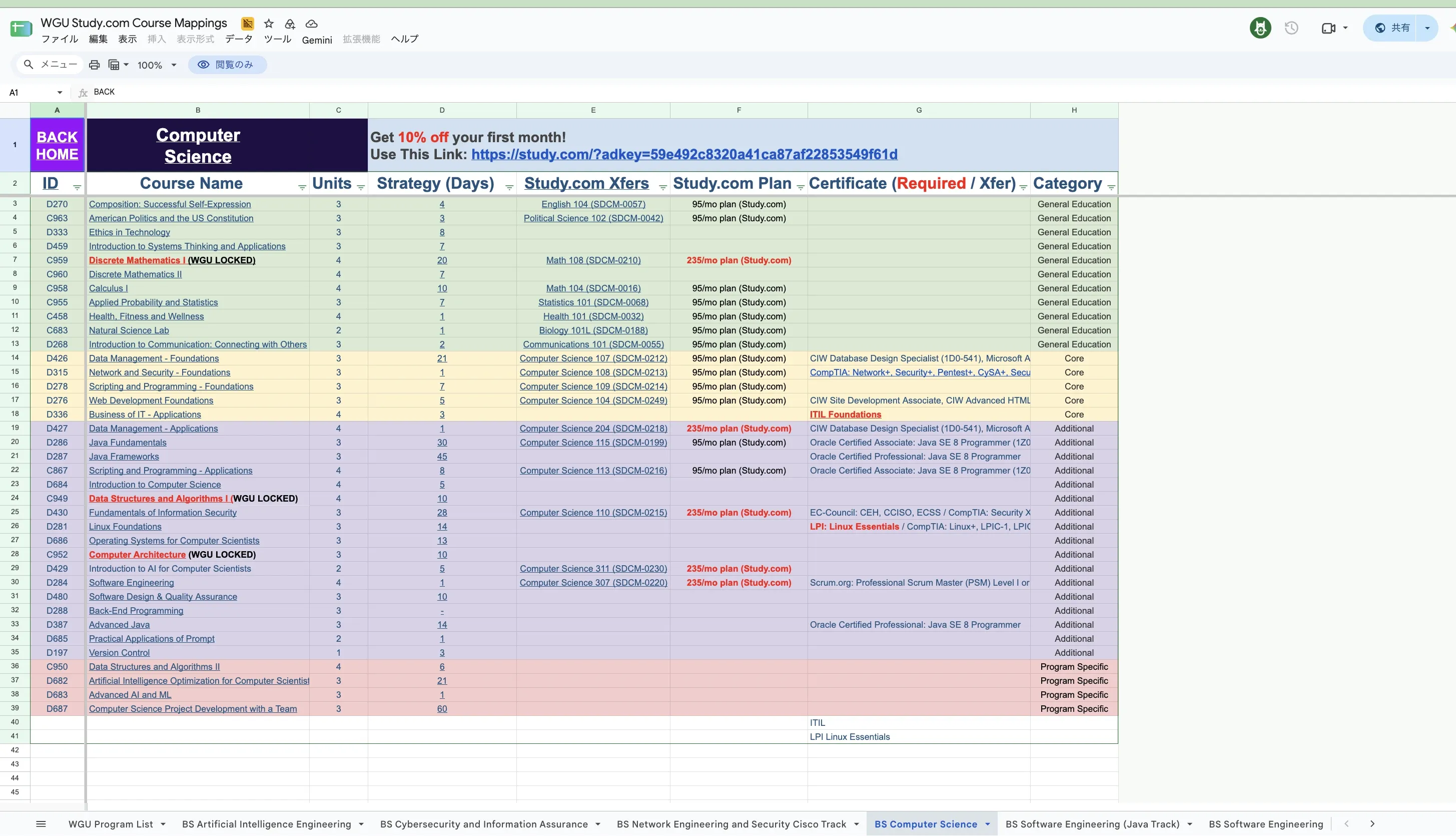
| WGU Course | Units | Est. Days | Study.com Equivalent |
|---|---|---|---|
| Composition: Successful Self-Expression | 3 | 4 | English 104 |
| American Politics and the US Constitution | 3 | 3 | Political Science 102 |
| Calculus I | 4 | 10 | Math 104 |
| Applied Probability and Statistics | 3 | 7 | Statistics 101 |
| Health, Fitness and Wellness | 4 | 1 | Health 101 |
| Natural Science Lab | 2 | 1 | Biology 101L |
| Introduction to Communication | 3 | 2 | Communications 101 |
| Data Management – Foundations | 3 | 21 | Computer Science 107 |
| Network and Security – Foundations | 3 | 1 | Computer Science 108 |
| Scripting and Programming – Foundations | 3 | 7 | Computer Science 109 |
| Web Development Foundations | 3 | 5 | Computer Science 104 |
That’s 11 courses — over 30 units — you can potentially finish through Study.com before you even enroll at WGU. Three courses are locked at WGU no matter what: Discrete Mathematics I, Data Structures and Algorithms I, and Computer Architecture. Budget your hardest study time for those.
Study.com runs about $99–$230/month depending on the plan, billed month-to-month.
Step 3: Pre-Study During Your Buffer Period
Once your Study.com transfers are done, start WGU enrollment but ask to begin your term 1–2 months out. Use that buffer to pre-study your remaining hardest classes — especially Data Structures and Algorithms — using Reddit strategy write-ups from people who’ve already passed.
Step 4: Enroll and Execute
Once your term starts, work through the remaining classes as fast as you can while actually absorbing the material.
What this means for you: transfer everything Study.com allows, pre-study the locked/difficult classes during your buffer window, then execute fast once you’re officially enrolled. A more realistic timeline for most people is around a year, and you can likely finish for under $10,000 if you run this strategy well.
Should You Also Learn to Code?
Even outside software engineering, learn to use AI coding tools properly. Try building a full-stack app with a real database and authentication, and pay attention to why it’s built that way — don’t just prompt an AI and walk away with no idea what’s under the hood.
If you want a hands-on place to practice this kind of real-environment thinking, that’s the mindset behind the Cyber Range, a community I run for people breaking into IT and cybersecurity.
Bringing a CS Degree Into a Cybersecurity Career
A computer science background gives you a real edge in security work — understanding how systems and applications are built makes you dramatically better at defending them.
Weighing a CS degree against a cybersecurity-specific one? I compare that in my complete 365-day guide to WGU’s cybersecurity degree, and I cover whether a master’s is worth stacking on top in my WGU master’s breakdown. Already have some technical background and want to break into IAM specifically? Start with my data-driven IAM careers roadmap.
None of this — the degree, the certifications — turns into a job by itself. That’s what I built Cyber Range for: a live, production-style SOC environment with the same enterprise tools companies actually use, plus weekly coaching and an internship track. It’s $129/month with a 7-day trial. If you just want free resources and a community on the same path, Cyber Community is free with about 9.9K members.
Resources mentioned in this article: